Idon't know if it will be completely successful or not, but it combines things from years past that have been, so should be well on it's way to bringing us some more sales. I thought you would get some insight and some tips and hints from it. If you have ideas to add, please comment!!!
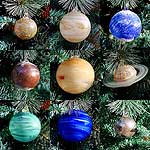
Next, we'll move into the process of creating the blown glass planets and Sun. The planets are supported by curved, hollow carbon fiber arms; the longest being 3 feet (1m), so the orbs must be very light. Just as in the Celestial Winds Blown Glass and Carbon Fiber Mobiles that we make, that have arms as long as 20 feet (6m), saving every ounce of mass that is way out on the end is very important. You're probably asking why we choose to pay that mass penalty when plastic could be used instead. Answer is simple:
A colleague in England posted today that he had a harrowing experience varnishing a painting when the varnish began dissolving some of the paints and started spreading them across the rest of his painting.
I've always dreaded the varnishing operation. You painstakingly coax every individual millimeter of a work to get them all to sing together in concert and it's finally finished. Then, you risk the whole darn thing on one swell foop by having to apply a substance that ubiquitously affects the entire thing all at once.
Two similar disasters come immediately to mind.

The Third Airborne Tank Division

I ran across a couple of articles today, one by Paul Gilster of the Tau Zero Foundation on Centauri Dreams entitled Space Art: Reviving the Imagination and another by Jeff Foust of The Space Review on When Space and Art Intersect. It's really good to see the resurgence in this area in so many circles and I thought I'd take a little break from The Making of the 21st Century Orrery series and get back to my original passion that started all this — Space Art. That is, Space Art in the classical sense that people know it; 2D paintings.
I've been having fun with both the small format of ACEOs (art cards), and also the watercolor techniques. Since most of my paintings are usually done with acrylics on glass, having the white paper as a start and then having the paints absorb into it are new for me. It takes a lot of getting used to. The biggest thing is getting used to working from back to front instead of details first like I have to do in my glass paintings. I find that I keep putting details down and then they get overrun or covered completely when I have to lay in a bigger wash of color. There are a lot of D'Oh! moments learning a new medium. But it is fun too.
Well, I said I was going to do it... It just took me a bit longer to rev up the time to sit down and actually get started. In my defense, though, we had that huge conference that takes over the whole studio for a good month or two - getting ready, getting stuff shipped, going and then the two weeks of recovery because I always seem to catch some hideous disease there or on the way back.
We recently had a booth set up at the National Space Symposium. We are usually the only artists that have a booth - the anomaly. We do a lot of work for the Space Foundation, which runs the symposium, including moving the large sculpture that goes on display for this symposium, so we have an exhibit in the hall during the week while we're taking care of their big glass sculpture.
I wanted to experiment with my sandblasting and deep carving on glass. My cast glass pieces are usually in the 3/8-1/2 inch thick range, with the colors swirling through the entire depth of the piece. This would make for some great carving, as some of the colors would be opened up, while others would remain untouched.
Since I was getting ready for a space conference, I decided to go with a spacey design. I had a section of glass that for all the world looks like boiling fire, so chose to carve a rocket ship taking off into the front of it. This would be just a display piece, as an example of the type of work we can do on counter tops, sinks, doors, etc.
I have never been a fast painter. I see friends who bang out piece after piece during a day. Why can't I get the hang of trusting what I feel and slapping it down? Instead, I tend to linger, plot out the strokes, the colors. In the end, I often end up ruining a perfectly good painting by overworking it. Being a good artist is also knowing when to quit, so I guess I'm not such a good artist sometimes.
Previous posts have focused on the rocket that is the center column for our orrery. The one pictured here doesn't have the bottom section with the fins, but our new one does. Now that the rocket has been carved and the holes bored into it to accept the drive tubes, it can be put aside for a bit and we move on to the next section - The arms.

Orrery Model Top and Arms